In the age of artificial intelligence, the gravest threat to human civilisation is not the destruction of books, but the quiet disappearance of their readers.
There was a time when tyrants feared books. They burnt libraries, banned manuscripts, imprisoned writers and executed philosophers. They did so because they believed a society that reads is difficult to control, and impossible to enslave. Today, no dictator needs to burn a single book. We are doing it ourselves. The greatest tragedy of the 21st century is not that books are disappearing. It is that readers are.
This week, The Atlantic published Rose Horowitch’s thought-provoking but unsettling essay, ‘The End of Reading Is Here’, arguing that we are entering a “post-literate age”. Her observation is outright grim: reading is fast becoming passé, with people, young and old, spending lesser time with the written word. The danger, she says, is not merely socio-cultural but also reflects on the kind of government and governance we end up getting.
Nearly four decades ago, Neil Postman anticipated this moment in Amusing Ourselves to Death. Contrasting George Orwell’s 1984 with Aldous Huxley’s Brave New World, Postman argued that Orwell feared a society where books would be banned, while Huxley imagined one where books would simply become irrelevant because people would no longer want to read them.
“Orwell feared those who would deprive us of information. Huxley feared those who would give us so much that we would be reduced to passivity and egoism. Orwell feared that the truth would be concealed from us. Huxley feared the truth would be drowned in a sea of irrelevance. Orwell feared we would become a captive culture. Huxley feared we would become a trivial culture, preoccupied with some equivalent of the feelies, the orgy porgy, and the centrifugal bumblepuppy,” Postman wrote quite presciently.
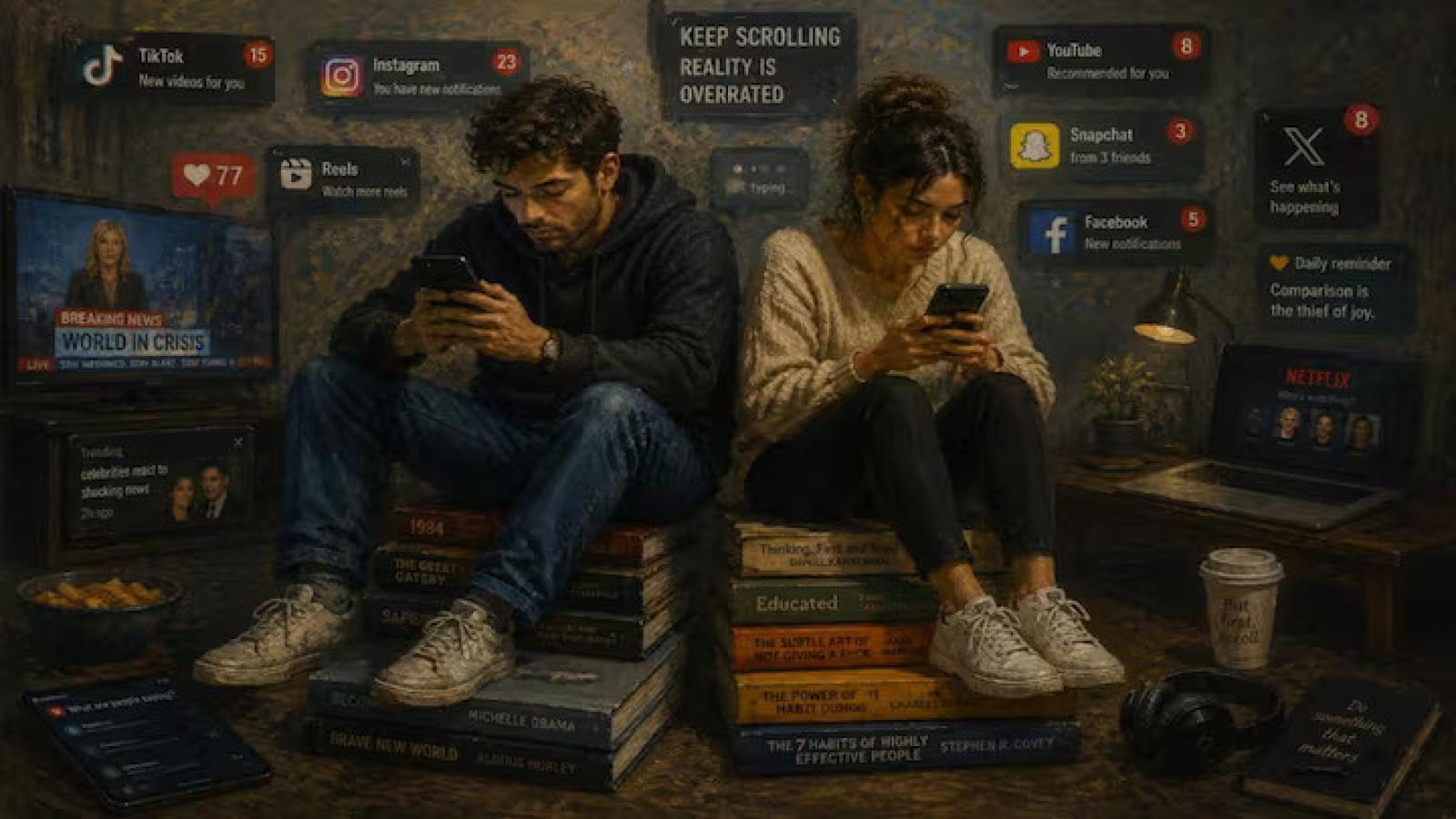
Today, it is Huxley’s vision that appears closest to reality. Nobody is preventing us from reading. Libraries remain safe and wide open. Books are more accessible than at any point in history. Yet, millions have voluntarily abandoned them. The decline of reading is not the consequence of censorship but of distraction. We have not lost books; instead, we have lost the appetite to read them.
Books and the culture of reading them voraciously have been the engines of modern civilisation as we know it today. Yes, of course, colonial plunder and imperialist greed played a big role, especially in the rise of the West. But equally important was the role played by the Enlightenment, the scientific revolution, constitutional democracy, industrialisation and modern education, all carried forward by the written word.
But then came the digital revolution, led by smartphones and now taken to a new, maddening height by the AI phenomenon. As Sven Birkerts argues in The Gutenberg Elegies, digital culture has produced “the triumph of the factual”. Reading, he writes, is not merely decoding words but “a filtering of the complexities of the real through artistic narrative, reflection, and orchestration of verbal imagery… The electronic impulse works against the durational reverie of reading. And however much other media take up the slack — of storytelling, say — what is lost is the contemplative register. And this, in the chain of consequences, alters subjectivity, dissipates its intensity.”
The outcome of this shift is increasingly difficult to ignore. Across the United States, reading for pleasure has fallen sharply over the past two decades. In Britain, more than a third of adults concede that they no longer read books regularly. Bharat is following a similar trajectory. The latest Time Use Survey, for instance, shows leisure reading declining between 2019 and 2024. At first glance, the fall — from 5.4 per cent of Indians reading for leisure to just 4 per cent — may appear modest. But behind those percentages lie millions of people who have quietly abandoned books, and with them the very faculty of thinking and contemplation.
Children still read, but increasingly because schools force them to. Adults in their 20s, 30s and 40s hardly read for pleasure any more. Even senior citizens — traditionally the most loyal readers — are spending less time with books.
If a 2016 Nielsen report is any indication, the average American spends more than 10 hours a day on digital devices. That amounts to nearly two-thirds of every waking hour, leaving little time for reflection, conversation or reading. The trend is hardly unique to the United States; if anything, screen time has only increased worldwide over the past decade. For Gen Z in particular, the smartphone has become the primary gateway to information, entertainment, and even human relationships.
This has made people, especially young ones, parasitic in nature. In Decline in Reading: How to Reverse the Trend, author Brian Yang argues that students today increasingly believe they no longer need to master reading or writing because technology speaks, listens and responds on their behalf. “With technology at their fingertips, they can simply speak their commands, and the devices around them respond. We’ve built tools to help them express themselves, but in doing so, we may have inadvertently stifled their ability to think critically and creatively.”
The outcome is devastating. Even in the topmost colleges and universities, professors increasingly report that students struggle to finish even modest reading assignments. Works that once formed the foundation of higher education now appear almost inaccessible. An English professor in the United States — quoted by The Atlantic in another article, ‘The Elite College Students Who Can’t Read Books’ — recalls how, 20 years ago, students eagerly discussed Pride and Prejudice one week and Crime and Punishment the next. “Now his students tell him up front that the reading load feels impossible. It’s not just the frenetic pace; they struggle to attend to small details while keeping track of the overall plot.”
Looking back, history has witnessed the destruction of knowledge before. The burning of the great Library of Alexandria in the 4th century marked more than just the loss of manuscripts in the ancient world. It symbolised the collapse of an intellectual civilisation. As Catherine Nixey writes in The Darkening Age, quoting one Greek professor as saying in utter despair: “The dead used to leave the city alive behind them, but we are now carrying the city to her grave.”
Bharat experienced its own tragedy when Bakhtiyar Khilji destroyed Nalanda in the late 12th century. One of the world’s greatest universities, it attracted scholars and students from across Asia. Its library had nine million handwritten palm-leaf manuscripts, and, according to legend, when Khilji burnt the university in 1193 AD, the fire in the library raged for months.
While Alexandria’s burning ushered in the Dark Ages in Europe, Nalanda’s decimation brought intellectual decline to Bharat. The loss was momentous, but over the passage of time, a sense of intellectual enquiry was regained. This time, however, the crisis may not be so obvious, but it remains far more existential and catastrophic. Today, the libraries remain open and the books survive, but the readers are disappearing. What violence destroys can eventually be rebuilt. But when a society willingly abandons its own core attribute, it becomes nearly impossible to recover.
The next dark age will not begin with flames consuming books. It will begin with perfectly preserved libraries standing empty while billions stare silently into glowing screens. And when the last generation of readers disappears, humanity will finally inherit Huxley’s world that might be ‘new’, perhaps, but no longer ‘brave’ and scarcely ‘human’.
(The writer is the author of ‘Bharat Rising: Dharma, Democracy, Diplomacy’ and ‘Eminent Distorians: Twists and Truths in Bharat’s History’. Views expressed in the above piece are personal and solely those of the author. They do not necessarily reflect Firstpost’s views.)
Books and voracious reading built modern civilisation; as readers disappear in the digital age, our intellectual future grows increasingly uncertain. (AI image)
- Se connecter ou s'inscrire pour publier un commentaire
- 249 vues

12/10/2026 - 12:51

Ferriòl Macip
08/10/2026 - 11:43

Aomar Mohhellebi ("L'Expressiondz.com")
30/09/2026 - 11:02


18/09/2026 - 10:39