
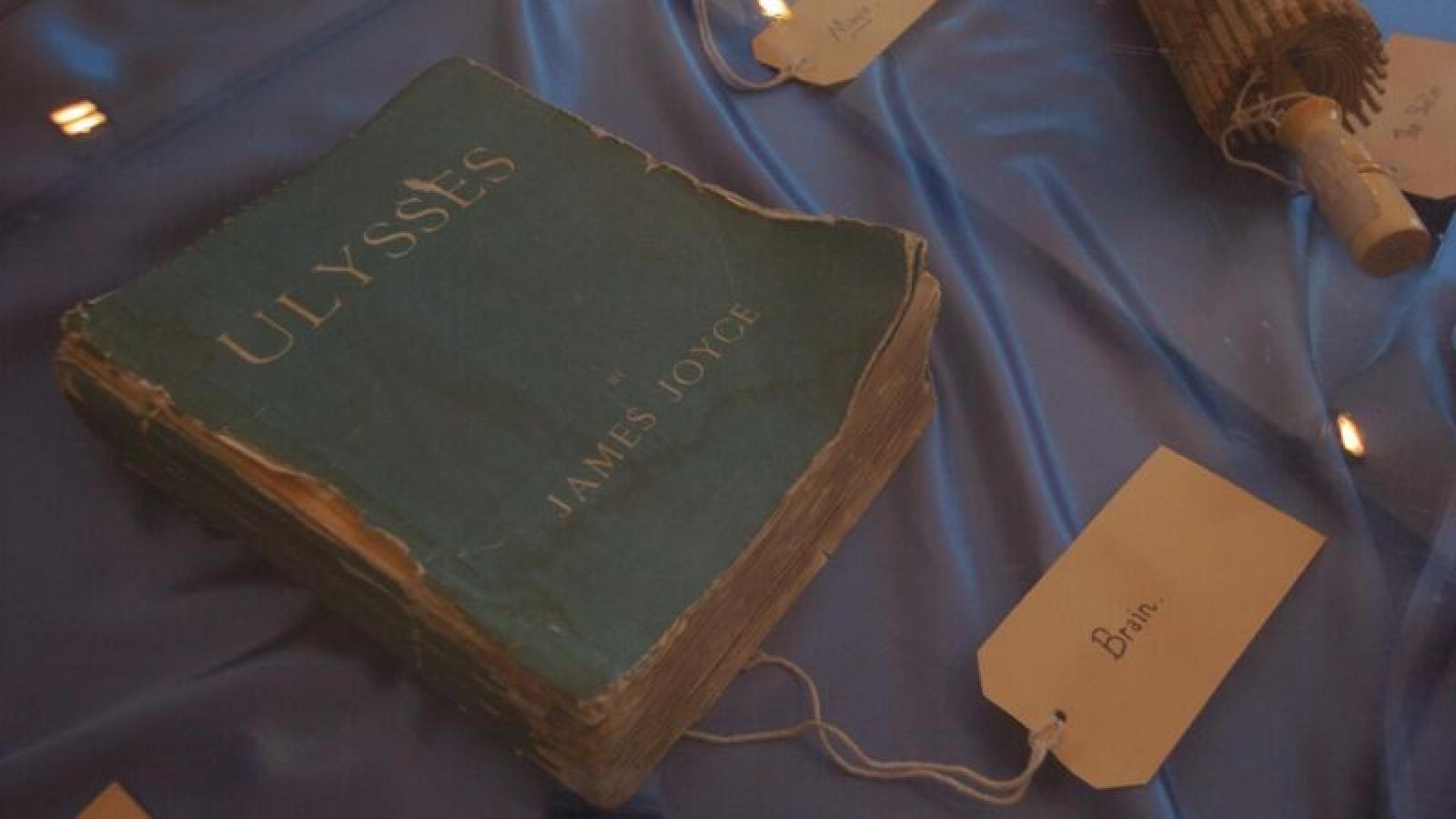
Ulysses, the groundbreaking modernist novel by James Joyce, marked its 100-year anniversary last year; it was first published on February 2, 1922. The poet T.S. Eliot declared the novel to be "the most important expression which the present age has found," and Ulysses has accumulated many other fans in the ages since. Count Harry Manos, an English professor at Los Angeles City College, among those fans. Manos is also a fan of physics—so much so, that he penned a December 2021 paper published in The Physics Teacher, detailing how Joyce had sprinkled multiple examples of classical physics throughout the novel
"The fact that Ulysses contains so much classical physics should not be surprising," Manos wrote. "Joyce’s friend Eugene Jolas observed: 'the range of subjects he [Joyce] enjoyed discussing was a wide one … [including] certain sciences, particularly physics, geometry, and mathematics.' Knowing physics can enhance everyone’s understanding of this novel and enrich its entertainment value. Ulysses exemplifies what physics students (science and non-science majors) and physics teachers should realize, namely, physics and literature are not mutually exclusive."
Ulysses chronicles the life of an ordinary Dublin man named Leopold Bloom over the course of a single day: June 16, 1904, (now celebrated around the world as Bloomsday). While the novel might appear to be unstructured and chaotic, Joyce modeled his narrative on Homer's epic poem the Odyssey; its 18 "episodes" loosely correspond to the 24 books in Homer's epic. Bloom represents Odysseus; his wife Molly Bloom corresponds to Penelope; and aspiring writer Stephen Dedalus—the main character of Joyce's semi-autobiographical A Portrait of the Artist as a Young Man (1916)—represents Telemachus, son of Odysseus and Penelope.
In his paper, Manos notes that the fictional Bloom fancies himself a man familiar with science, but Joyce slyly shows his protagonist to be a dilettante whose knowledge stems primarily from the popular science books available at the time—which would certainly explain certain misconceptions Bloom holds. For instance, when Bloom invites Dedalus to his home, he tries to impress the young man by declaring that it is possible to see the Milky Way during the day if the observer were "placed at the lower end of a cylindrical vertical shaft 5000 ft [sic] deep sunk from the surface towards the center of the Earth."

Enlarge / James Joyce with Sylvia Beach, owner of the Paris bookstore Shakespeare and Company, in March 1930. Beach was the first to publish Ulysses in 1922.
Keystone-France/Gamma-Keystone/Getty Images
This is false, of course; Manos writes that Rayleigh scattering would render the stars invisible—even from the bottom of a cylindrical vertical shaft or tall chimney. Where might Bloom have acquired this misconception? Manos notes that Sir Robert Ball, at the time director of the Dunsink Observatory just north of Dublin, had published two popular books. Dedalus spots one of them, The Story of the Heavens, in Bloom's library. The other was called Star-Land, which talks about being able to see stars in daylight from the bottom of a mineshaft or tall chimney. If Bloom possessed the first book, it's highly likely he would also have read Star-Land—hence his misconception.
Other physics examples reflect the accepted science of that time, even though subsequent advances rendered that science incorrect. For instance, Bloom ruminates on how heat is transferred through convection, conduction, and radiation while boiling water for tea, including a mention of how the Sun's radiant heat is "transmitted through omnipresent luminiferous diathermanous ether." At the time, some physicists still believed in the existence of a luminiferous ether that served as the medium through which light traveled. It was eventually disproved—thanks to the famous Michelson-Morley experiment in 1887 and Albert Einstein's development of special relativity and his paper on the photoelectric effect in 1905 (his annus mirabilis). But Manos notes that a high school textbook contemporary with the novel's 1904 setting still referenced the ether as a scientific fact.
In Chapter 15 ("Circe"), one of the characters says, "You can call me up by sunphone any old time"—a phrase that also appears in Joyce's handwritten notes for the chapter. While Manos was unable to trace a specific source for this term, there was a similar device that had been invented some 20 years earlier: Alexander Graham Bell's photophone, co-invented with his assistant Charles Sumner Tainter.
Advertisement

Enlarge / A photophone transmitter showing the path of reflected sunlight, before and after being modulated.
Public domain
Unlike the telephone, which relies on electricity, the photophone transmitted sound on a beam of light. Bell’s voice was projected through the instrument to a mirror, causing similar vibrations in the mirror. When he directed sunlight into the mirror, it captured and projected the mirror’s vibrations via reflection, which were then transformed back into sound at the receiving end of the projection. Bell’s device never found immediate application, but it's arguably the progenitor to modern fiber-optic telecommunications.
There are several other instances of physics (both correct and incorrect/outdated) mentioned in Ulysses, per Manos, including Bloom misunderstanding the science of X-rays; his confusion over parallax; trying to figure out the source of buoyancy in the Dead Sea; ruminating on Archimedes' "burning glass"; seeing rainbow colors in a water spray; and pondering why he hears the ocean when he places a seashell to his ear. Manos believes introducing literature like Ulysses into physics courses could be a boon for non-majors, as well as encouraging physics and engineering students to learn more about literature.
In fact, Manos notes that an earlier 1995 paper introduced a handy introductory physics problem involving distance, velocity, and time. Ulysses opens with Stephen Dedalus and his roommate, Buck Mulligan, standing at the Martello tower overlooking a bay at Sandy Cove. Mulligan is shaving and slyly performs an "apparent miracle": he whistles, and a few moments later a passing mailboat whistles back. Mulligan had spotted the mailboat through his shaving mirror giving its usual two blasts at that time of the morning, about a mile away.
Using a simple equation (t = d/v), "Students can easily calculate that at the speed of light, Mulligan would have seen the steam in 5.4 ×10⁻⁶ s, with the whistle blast," Manos wrote. "At 1100 ft/s, the sound would have traversed the mile to the Martello tower in 4.8 s, giving Mulligan time to whistle to the heavens and wait (“paused”) for the heavens (the mailboat’s departure whistle) to reply, thus pulling off his apparent miracle."
An early edition of one of Dublin's most famous literary masterpieces: Ulysses by James Joyce, published in 1922.
- Se connecter ou s'inscrire pour publier un commentaire
- 191 vues

Amina Aouadi ("Algerie360.com")
23/10/2026 - 10:20

12/10/2026 - 12:51

Ferriòl Macip
08/10/2026 - 11:43

Aomar Mohhellebi ("L'Expressiondz.com")
30/09/2026 - 11:02