Kenyan writer’s death announced by his daughter, who wrote: ‘He lived a full life, fought a good fight’
The Kenyan writer Ngũgĩ wa Thiong’o, who was censored, imprisoned and forced into exile, a perennial contender for the Nobel prize for literature and one of few writers working in an indigenous African language, has died aged 87.
“It is with a heavy heart that we announce the passing of our dad, Ngugi wa Thiong’o, this Wednesday morning,” wrote his daughter Wanjiku wa Ngũgĩ on Facebook. “He lived a full life, fought a good fight.”
He died in Atlanta, and his daughter said more details would be announced soon.
“I am me because of him in so many ways, as his child, scholar and writer,” his son Mũkoma wa Ngũgĩ wrote on X. “I love him - I am not sure what tomorrow will bring without him here. I think that is all I have to say for now.”
Ngũgĩ explored the troubled legacy of colonialism through essays, plays and novels including Weep Not, Child (1964), Devil on the Cross (1980) and Wizard of the Crow (2006). Considered a giant of the modern African pantheon, he had been a favourite for the Nobel prize in literature for years. After missing out on the prize in 2010 to Peruvian author Mario Vargas Llosa, Ngũgĩ said he was less disappointed than the photographers who had gathered outside his home: “I was the one who was consoling them!”
Born in 1938, while Kenya was under British colonial rule, Ngũgĩ was one of 28 children, born to a father with four wives. He lived through the Mau Mau uprising as a teenager, during which the authorities imprisoned, abused and tortured tens or even hundreds of thousands of people. During the conflict, Ngũgĩ’s father – one of the Gikuyu, Kenya’s largest ethnic group – was forced off his land, and two of his brothers were killed.
This struggle formed the backdrop to the novel that made his name: Weep Not, Child. Published in 1964, just a year after Kenya gained independence, it tells the story of the education of Njoroge, the first of his family to go to school, and how his life is thrown into turmoil by the events that surround him.
A series of novels, short stories and plays followed, as Ngũgĩ became a lecturer in English literature at Nairobi University. There, he argued that the English department should be renamed, and shift its focus to literature around the world. “If there is need for a ‘study of the historic continuity of a single culture’, why can’t this be African?” he wrote in a paper. “Why can’t African literature be at the centre so that we can view other cultures in relationship to it”
In 1977, he published his fourth novel, Petals of Blood, and a play, The Trial of Dedan Kimathi, which dealt with the troubled legacy of the Mau Mau uprising, but it was his co-authoring of a play written in Gikuyu, I Will Marry When I Want, which led to his arrest and imprisonment in Mamiti maximum-security prison.
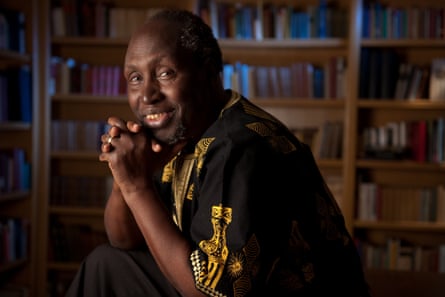
Ngũgĩ wa Thiong’o, at the University of California, Irvine, on 6 October 2010. Photograph: Daniel A Anderson
“In prison I began to think in a more systematic way about language,” he told the Guardian in 2006. “Why was I not detained before, when I wrote in English?” He decided from then on to write in Gikuyu, that “the only language I could use was my own”.
Although he was released in 1978, exile followed in 1982, when the author learned of a plot to kill him upon his return from a trip to Britain to promote his novel Caitani Mutharabaini, translated as Devil on the Cross. He later moved from the UK to the US, where he worked as a professor of English and comparative literature at the University of California, Irvine, and headed its International Centre for Writing and Translation.
Ngũgĩ continued to write in Gikuyu, despite his troubled connection with his homeland; an arrest warrant was issued for the fictional main character of his 1986 novel Matigari, which was also banned in Kenya. Returning to Nairobi with his wife, Njeeri, for the first time in 2004, two years after the dictator Daniel arap Moi stepped down, Ngũgĩ was greeted by crowds at the airport. But during the trip, men wielding guns broke into their apartment, raping Njeeri and beating Ngũgĩ when he tried to intervene. “I don’t think we were meant to come out alive,” he told the Guardian two years later.
His novel Wizard of the Crow, translated by the author into English in 2006, returned to the subject of African kleptocracy, being set in the imaginary dictatorship of the Free Republic of Aburiria. He said the “most beautiful sentence in the entire novel” was “a translation from Gikuyu by the author”.
He continued to translate his own works from Gikuyu, and was nominated for the international Booker prize in 2021 for his epic novel-in-verse The Perfect Nine. He was the prize’s first nominee writing in an indigenous African language and the first author to be nominated for their own translation.
Ngũgĩ was diagnosed with prostate cancer in 1995 and underwent triple heart bypass surgery in 2019.
He had nine children, four of whom are authors: Tee Ngũgĩ, Mũkoma wa Ngũgĩ, Nducu wa Ngũgĩ, and Wanjiku wa Ngũgĩ.
“Resistance is the best way of keeping alive,” he said to the Guardian in 2018. “It can take even the smallest form of saying no to injustice. If you really think you’re right, you stick to your beliefs, and they help you to survive.”
This article was amended on 29 May 2025. Ngũgĩ wa Thiong’o was initially imprisoned under the government of Jomo Kenyatta, not that of Daniel arap Moi, as an earlier version indicated. Also, 2004 was two years after Daniel arap Moi stepped down, not two years after his death; he died in 2020.
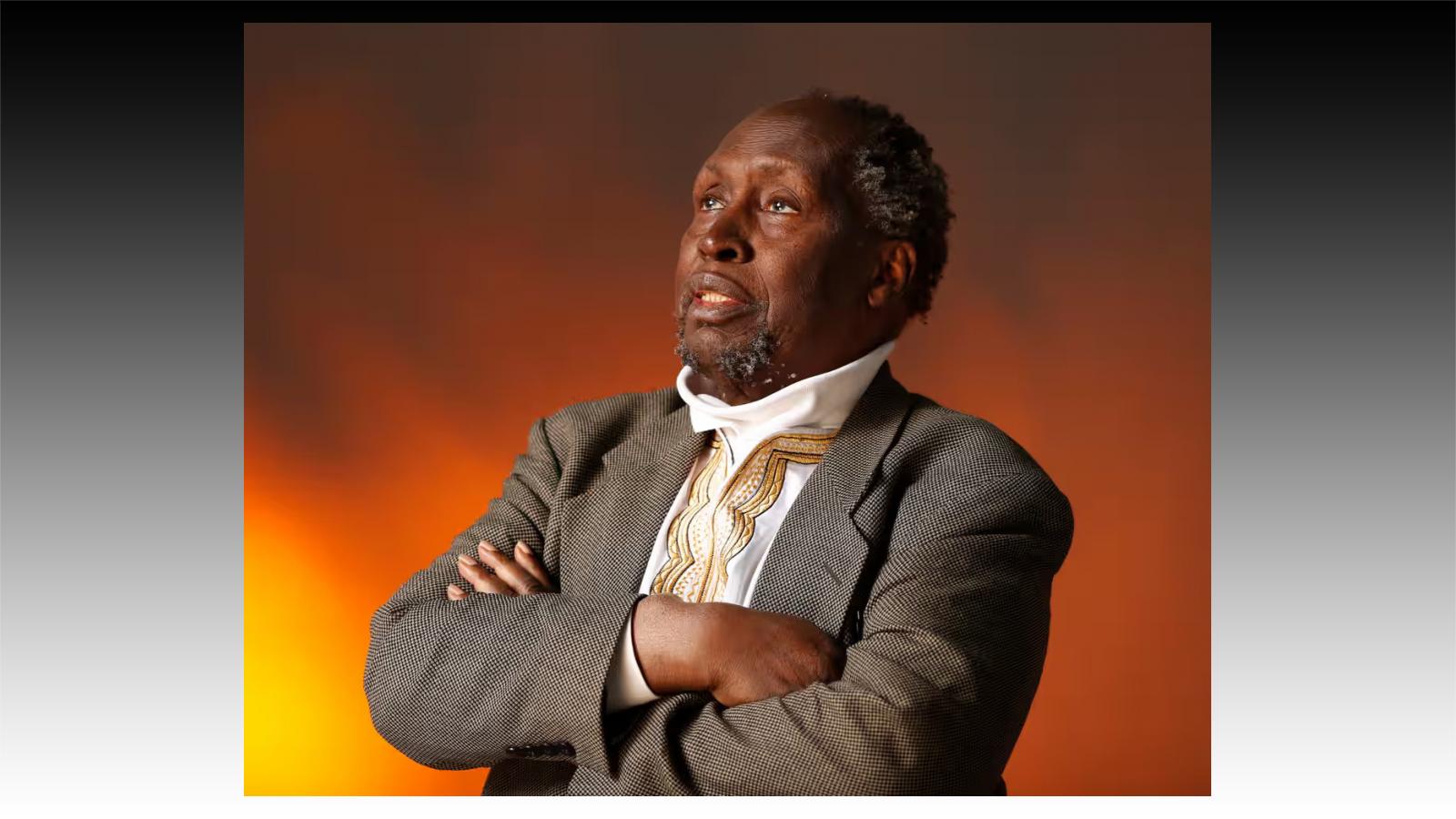
Ngũgĩ wa Thiong’o, pictured at the Edinburgh international book festival in 2018. Photograph: Murdo Macleod/Guardian
- Se connecter ou s'inscrire pour publier un commentaire
- 221 vues
18/09/2026 - 10:39
Nicolas Gary
31/08/2026 - 11:28
Gordon Henderson
16/08/2026 - 22:48